

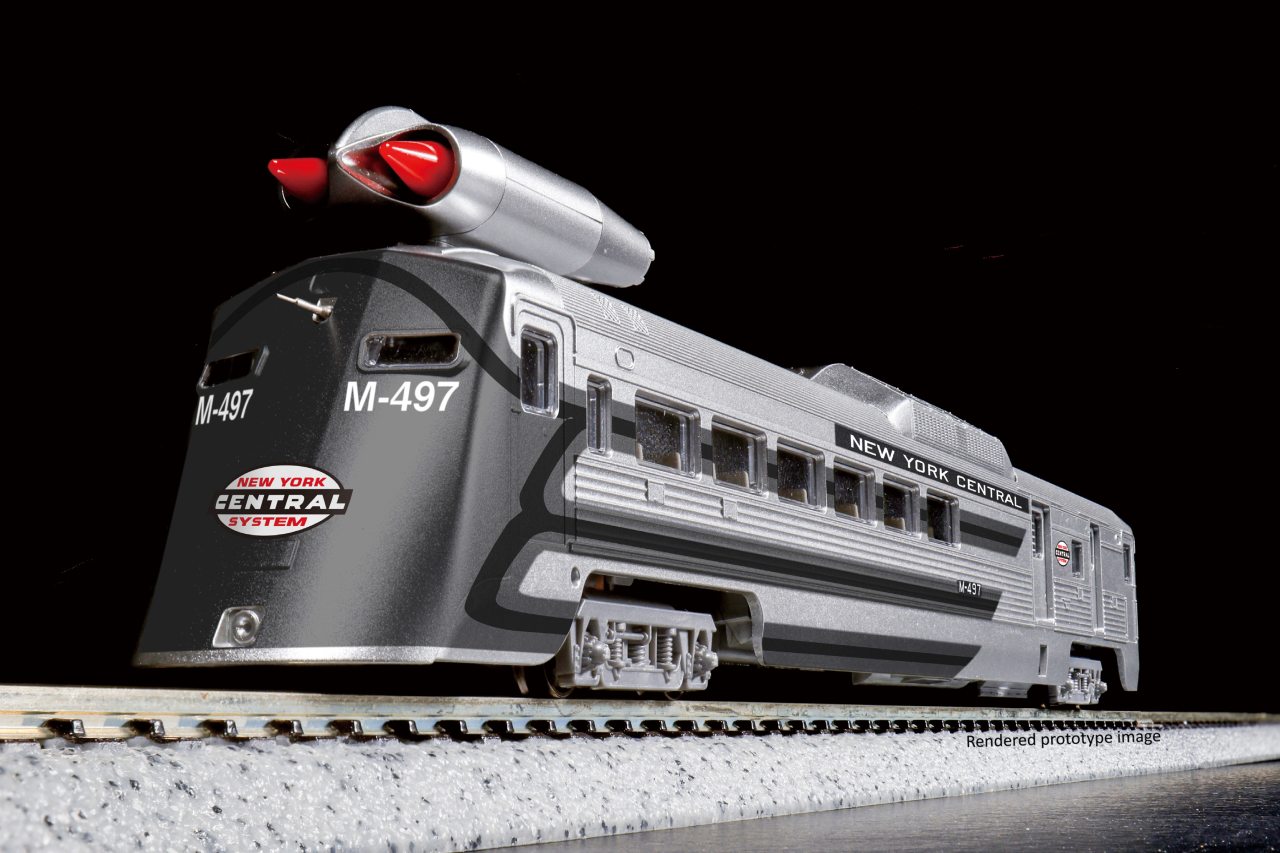
Kato N NYC Jet Powered RDC M-497 Black Beetle (Sonderserie)
Beschreibung und Informationen zu diesem Artikel:
1966: America's Rail Revolution
The 1960s were a decade in which the world pursued the possibilities of high-speed rail. Japan opened the Shinkansen, while France advanced research that would later lead to the TGV. In both countries, high-speed rail development was based on the concept of dedicated high-speed lines. The United States, on the other hand, explored a different approach: achieving high-speed transportation by making use of existing rail infrastructure.
One of the most ambitious experiments born from this research was the Jet Powered RDC #M-497, a test vehicle equipped with aircraft jet engines. Its innovative concept and unique design secured its place in railway history.
This winter, KATO will release this legendary train as an N-gauge model!
Product Features:
- Jet engine exhaust nozzles which light up during operation
- Authentic silver livery with grey striping
- Working headlight on the streamlined cowl
- Smooth, reliable GM-5 motor
- Standard knuckle coupler on the non-cowled cab end
Context
In the 1960s, the rapid expansion of the interstate highway network and the growing popularity of jet airliners placed American passenger rail service in a period of steep decline. The New York Central Railroad (NYC) continually explored new ways to restore rail's competitive edge through fast, comfortable intercity transportation.
In 1966, with the approval of then-president Alfred E. Perlman, a high-speed testing program utilizing aircraft jet engines was launched. At the center of the project was Don Wetzel, a man with an unusual background as both an airline pilot and a qualified steam locomotive engineer. Given just 30 days to prepare, Wetzel and his team were forced to move ahead at an extraordinary pace.
From Commuter Train to High-Speed Test Vehicle
The purpose of the program was not to break speed records or develop new train design, but rather to measure vehicle and track performance at high speeds and evaluate the feasibility of high-speed transportation over existing railway lines. For this reason, instead of designing an entirely new test vehicle, New York Central selected a Budd-built RDC-3 railcar that had already been in service with the railroad for 13 years as the basis for the project.
The vehicle was transported to the railroad's technical research facilities and fitted with two surplus General Electric J47 jet engines acquired from the U.S. Air Force. More than 50 measuring instruments were installed throughout the train to record data such as speed, stress, vibration, axle-bearing temperatures, and track conditions, transforming it into a highly specialized test vehicle.
Its distinctive streamlined nose was developed through wind-tunnel testing, and a pitot tube for speed measurement was mounted beneath the front end. The RDC-3 was thus transformed into the M-497, a purpose-built vehicle for high-speed rail research.
Achieving 295.86 km/h
During a two-day series of high-speed tests conducted on July 23-24, 1966, the M-497 achieved a top speed of 183.85 mph (295.86 km/h). To this day, it remains one of the most notable speed records in North American railway history. Remarkably, this speed was attained on existing railway infrastructure and far exceeded the 200 km/h maximum operating speed of the 0 Series Shinkansen.
After the program concluded, M-497 was displayed in New York before being restored to its original configuration and returned to passenger service as an RDC. Retired in 1977 and scrapped in 1984, it remains remembered for its distinctive appearance and the bold vision that made it a unique chapter in high-speed rail history.
(Neuheiten_2026_N_Kato_Juli)